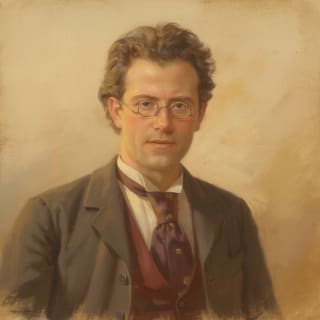
Gustav Mahler quotes
1860 – 1911 · Austrian Empire, 19th and 20th centuries · composer and conductor
About Gustav Mahler
Born on 7 July 1860 in Kaliště, he was appointed in 1897 as director of the Vienna Court Opera, where he spent ten years. He died in Vienna on 18 May 1911.
Works: Symphony No. 1, Symphony No. 2, Symphony No. 5, Symphony No. 8
Quotes
“What is best in music is not to be found in the notes.”
Source: *Gustav Mahler*, Passage concerning Mahler's conducting and the relation between the score and musical expression, 1958 · Check the source
Verified attributionWhat we know
- What remains uncertain
- Translation: translated by Adagely.
Bruno Walter recalls that Mahler felt the score was only the starting point for music-making. In his account, the best in music is not set down in the notes. Walter ties this remainder beyond the written score to Mahler's conducting, described as passionate and like a personal confession.
“If a composer could say what he had to say in words he would not bother trying to say it in music.”
Source: no specific work is documented
Source not foundWhat we know
- What remains uncertain
- Translation: translated by Adagely.
“God can only be comprehended as Love.”
Source: no specific work is documented
Source not foundWhat we know
- What remains uncertain
- Translation: translated by Adagely.
“I don't choose what I compose. It chooses me.”
Source: no specific work is documented
Source not foundWhat we know
- What remains uncertain
- Translation: translated by Adagely.
“I am thrice homeless, as a native of Bohemia in Austria, as an Austrian among Germans, and as a Jew throughout the world. Everywhere an intruder, never welcomed.”
Source: Alma Mahler, memoir, English edition, 1946, p. 89. · Check the source
Disputed attributionWhat we know
- What remains uncertain
- The words are not Gustav Mahler's own written text: they come to us through his wife's account. Translation: translated by Adagely.
“You must renounce all superficiality, all convention, all vanity and delusion.”
Source: no specific work is documented
Source not foundWhat we know
- What remains uncertain
- Translation: translated by Adagely.
“If you think you're boring your audience, go slower not faster.”
Source: no specific work is documented
Source not foundWhat we know
- What remains uncertain
- Translation: translated by Adagely.
“We all return. It is this certainty that gives meaning to life and it does not make the slightest difference whether or not in a later incarnation we remember the former life. What counts is not the individual and his comfort, but the great aspiration to the perfect and the pure which goes on in each incarnation.”
Source: no specific work is documented
Source not foundWhat we know
- What remains uncertain
- Translation: translated by Adagely.
“In Bach, the vital cells of music are united as the world is in God.”
Source: no specific work is documented
Disputed attributionWhat we know
- What remains uncertain
- Translation: translated by Adagely.
“The longer you live and the more you learn, the more clearly you will feel the difference between the few men who are truly great and the mere virtuosi.”
Source: no specific work is documented
Source not foundWhat we know
- What remains uncertain
- Translation: translated by Adagely.
“It is always the same with me; only when I experience something do I compose, and only when composing do I experience! After all, a musician's nature can hardly be expressed in words.”
Source: no specific work is documented
Source not foundWhat we know
- What remains uncertain
- Translation: translated by Adagely.
“The symphony must be like the world. It must embrace everything.”
Source: no specific work is documented · Check the source
Disputed attributionWhat we know
- What is documented
- The quotation is attributed to Gustav Mahler, not Jean Sibelius: it occurs in an account of Mahler's contrasting view of the symphony's nature.
- What remains uncertain
- These words are spoken by Gustav Mahler, replying to Jean Sibelius. Translation: translated by Adagely.
The words occur in an account of a conversation in which Jean Sibelius admires the symphony's severity of style and the profound logic creating an inner connection between all its motifs. Mahler answers with his contrasting view of the symphony's nature. For him, a symphony must be like the world and embrace everything.