Available on Android · web version on iPhone
One quote a day. One challenge to live it.
One quote. Your pace. Your way.
Every day, Adagely picks a verified quote for you — its story, its meaning, and three concrete challenges to bring it into your day.
Every day, a quote is waiting for you. Its story. Its meaning. Ideas to explore. Read or listen. Come back whenever you like.
Or live one Adagely day in 30 secondsTry it · 30 seconds
Live one Adagely day.
A beautiful line is not enough: you have to live it. Three quotes, your reactions, and Adagely picks yours: this is how the app gets to know you.
Quote 1 of 3
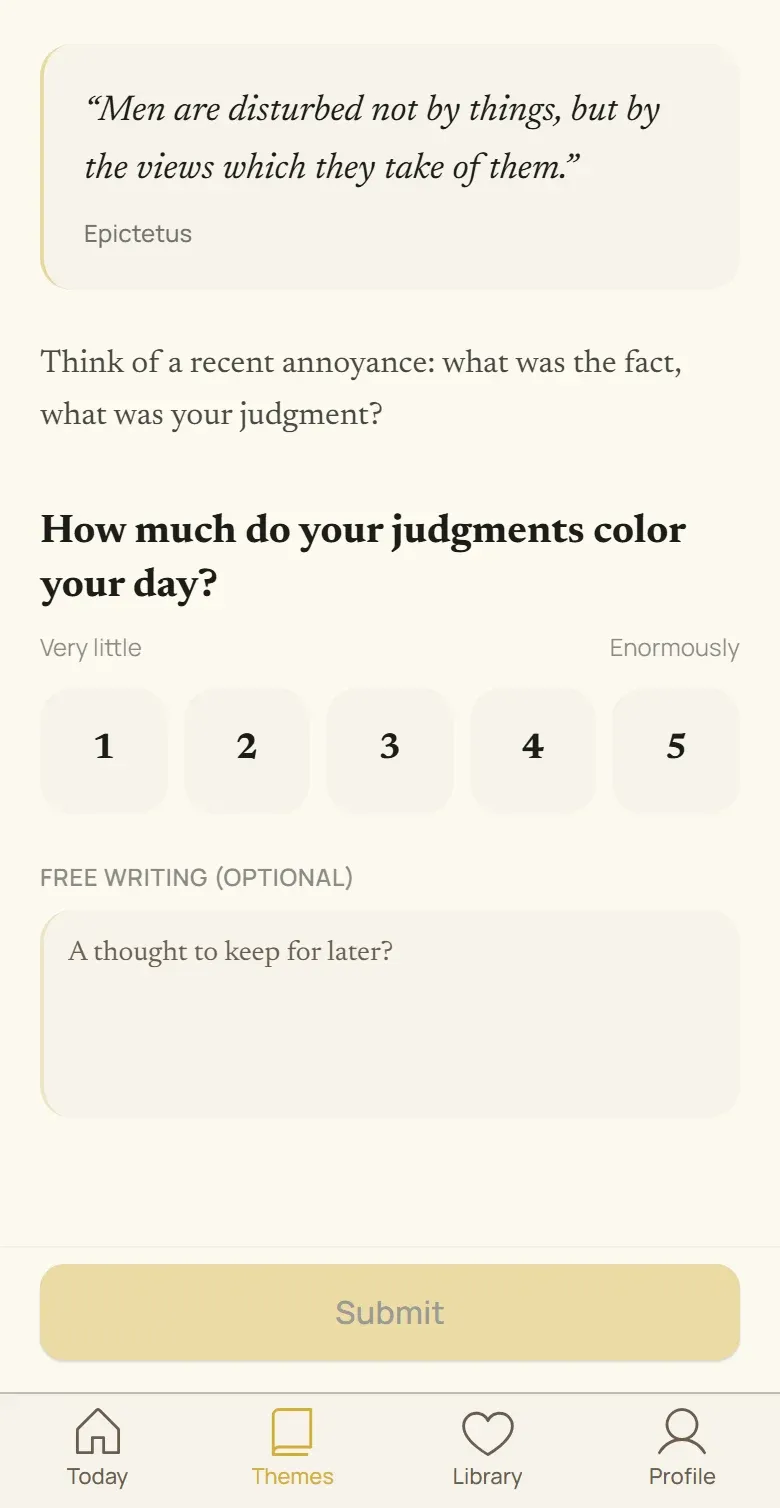
“It is not things that trouble us, but our judgments about things.”
How does this line make you feel?
Designed to suit you.
Adagely adapts to you — not the other way around.
Read or listen
An audio insight comes with the quote. Choose what works for you today.
Your pace, always
No streaks. No daily pressure. A new quote is waiting whenever you're ready.
Calm by design
Clean interface. Soft colours. No pop-ups, no flashing. Just the words that matter.
Explore, not perform
Ideas to try, not tasks to complete. Take what speaks to you, leave the rest.
You're in control
React to quotes to shape the next ones. AI is optional, and can be changed at any time in Profile.
Your journal, your words
A calm space to note what stayed with you. No prompts, no templates. Just you.
Every quote, a work of art.
Every quote, explained in detail.
Every quote carries its precise reference when there is one and its attribution status, then comes to life with its story and meaning. And when an attribution is doubtful, we tell you why.
“Fortune favors the bold.”
Source: Aeneid · Check the source
Verified attributionWhat we know
- What is documented
- The sentiment is securely Virgilian: it appears in the Aeneid and is spoken in the poem by the character Turnus.
- What remains uncertain
- The familiar English wording is a translation/normalization of the Latin and several Latin variants exist in tradition.
Roman poet of the Augustan age, author of the Eclogues, Georgics and the Aeneid, whose work shaped Rome’s literary memory.
Read the story behind this quote
Understand the quote
Born as a battle cry, the line claims decisive action wins the favor of Fortune. In Virgil it functions as a martial exhortation—invoking the goddess Fortuna—rather than a pop self-help tip. Over time it turned into a compact proverb about taking risks.
The story
Virgil was a leading poet of the Augustan age, born in 70 BC; the character who shouts the line in the epic ultimately meets defeat, complicating its celebration of daring.
In the original
Latin
Audentis Fortuna iuvat.
The full entry for this quote →One of its three challenges
Start a bold mini-run: run for 15 minutes on an unfamiliar route today, without your usual playlist or active GPS.
Moving into the unknown reenacts the quote: decisive action in uncertainty invites new chances. Physical daring sharpens readiness to act.
The exact quote
Its precise reference, and what we know of its attribution: verified, disputed, misattributed or not found.
The author & their era
Portrait, biography, works: who is speaking, and from what world.
The story
The anecdote behind the words — when, where and why they were born.
The context
The era, the philosophy, and those who have quoted it over the centuries.
The original text
A translation is already an interpretation: read the thought as it was first written.
Audio insight
A few minutes to listen to, for the mornings you would rather close your eyes.
On the shoulders of giants
See all 162 authors and their quotes → Albert Einstein
- Bhagavad Gita
- Eric Roth
 F. Scott Fitzgerald
 Kendrick Lamar
 Paramahansa Yogananda
 T. D. Jakes
 14th Dalai Lama (Tenzin Gyatso)
 A. A. Milne
 Abraham H. Maslow
 Abu Hamid Muhammad ibn Muhammad al-Ghazali
 Agatha Christie
 Alain Mabanckou
 Albert Camus
 Albert Schweitzer
 Alfred Adler
 Ali al-Wardi
- Amadou Hampâté Bâ
 André Malraux
 Antoine de Saint-Exupéry
 Aristotle
 Aung San Suu Kyi
 Avul Pakir Jainulabdeen Abdul Kalam
 Barack Hussein Obama II
 Baruch Spinoza
 Bhagat Singh
 Blaise Pascal
 Bob Marley
- Buthaina Al-Eisa
 Byung-Chul Han
 Carl Gustav Jung
 Carl Ransom Rogers
 Charles Darwin
 Chinua Achebe
 Chris Evans
- Clarissa Pinkola Estés
 Confucius
 Crazy Horse
 C. S. Lewis
 Deborah Harkness
 Dejan Stojanović
 Derek Alton Walcott
 Diane Dufresne
 Dwight Lyman Moody
 Edith Eva Eger
 Édouard Herriot
 Eduardo Galeano
 Eleanor Roosevelt
 Elias Canetti
 Elie Wiesel
 Elif Shafak
 Emiliano Zapata
- Enock Maregesi
 Epictetus
 Ernest Hemingway
 Fannie Lou Hamer
 Fatema Mernissi
 Fernando Pessoa
 Francis of Assisi
 Franz Kafka
 Fredrik Backman
 Friedrich Wilhelm Nietzsche
 Fyodor Dostoevsky
 Gabor Maté
 Gautama Buddha
 George Bernard Shaw
 Hafez
 Haile Selassie I
 Harriet Tubman
 Haruki Murakami
 Henrik Ibsen
 Henry IV of France
 Herbert Bayard Swope
 H. Jackson Brown, Jr.
 Ibn Khaldun
 Ibrahim al-Koni
- Ibrahim Nasrallah
 Imbolo Mbue
 Immaculée Ilibagiza
 Isaac Newton
 Ivo Andrić
 Jalal ad-Din Muhammad Rumi
 Jean Cocteau
 Jean de La Fontaine
 Jean-Jacques Rousseau
 Jean Jaurès
 Jean-Paul Sartre
 John Emerich Edward Dalberg-Acton, 1st Baron Acton
 John Lennon
 Jorge Luis Borges
 José Eduardo Agualusa
 José Martí
 José Rizal
 Junot Díaz
 Kahlil Gibran
 Katherine Mansfield
 Kofi Annan
 Laozi
 Leonardo da Vinci
 Mahatma Gandhi (Mohandas Karamchand Gandhi)
 Mahmoud Darwish
 Marguerite Yourcenar
 Mariama Bâ
 Maria Montessori
 Marie Curie
 Marilyn Monroe
 Mario Vargas Llosa
 Mark Twain
 Martin Luther King Jr.
 Mary Tyler Moore
- Matshona Dhliwayo
 Mia Couto
 Michael Ondaatje
 Mikhail Afanasievich Bulgakov
 Mohammed Hasan Alwan
- Moses Isegawa
 Mother Teresa
 Muhammad Yunus
 Nelson Mandela
 Niccolò Machiavelli
 Nicky Gumbel
 Nicolas Boileau-Despréaux
 Nikola Tesla
 Nizar Qabbani
 Nouman Ali Khan
 Nuruddin Farah
 Oscar Wilde
 Pablo Neruda
 Patrice Émery Lumumba
 Paulo Coelho
 Pierre de Coubertin
 Publius Vergilius Maro (Virgil)
 Rachel Boston
- Renaud Dillies
 René Descartes
 Richard Rohr
 Robert Browning
- Romain Gary
 Samuel Beckett
 Seneca
 Shams Tabrizi
 Simone de Beauvoir
 Sir Winston Churchill
 Slavoj Žižek
 Snoop Dogg
 Socrates
 Søren Aabye Kierkegaard
 Tayeb Salih
 Thích Nhất Hạnh
 Thomas Alva Edison
 Tim Winton
 Tom Robbins
 Tove Jansson
 Tyga
 Victor Hugo
 Voltaire
 Wangari Muta Maathai
- William Arthur Ward
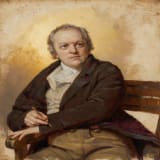 William Blake
- Yasmin Mogahed
- Yasser Harib
 Yuval Noah Harari
Go further.
Adagely journeys.
Go further. At your pace.
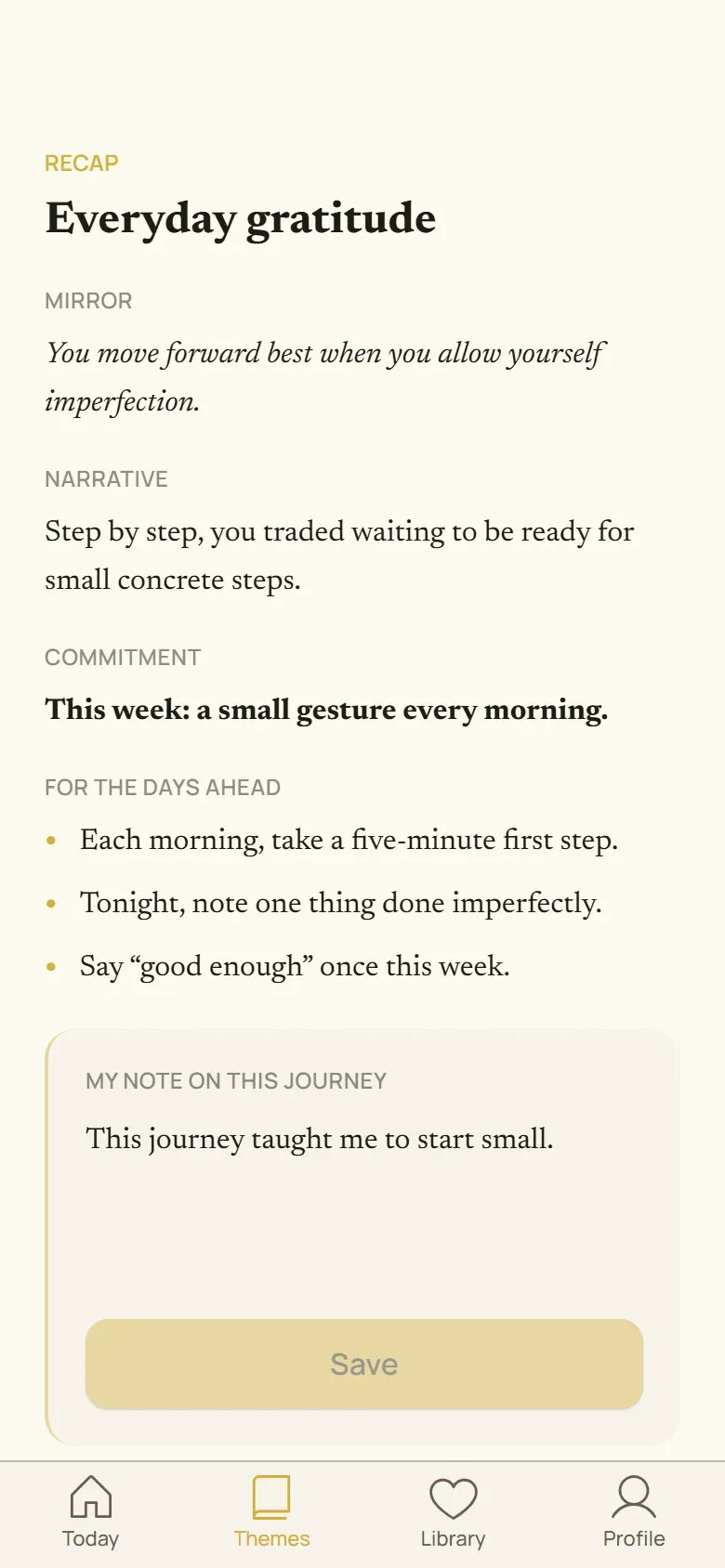
Not a list of quotes: seven steps to reflect on something that matters, and a summary that reflects you.
At every step of the journey
- 01
The quote
Verified, put in context, and tied to the theme of the journey.
- 02
Its insight
What this thought says about the topic — a different angle from the general explanation.
- 03
Your reflection
One question to see where you stand. Not a quiz — an invitation to take a position.
At the end of a journey
Your summary.
A mirror of the way you think, the story of your path, a commitment, and three to five concrete actions for the days ahead.
The summary goes into your journal, with your personal notes — to reread whenever you like.
Adagely knows you.
A little better each day.
Adagely adapts to your taste.
Turn on AI, and Adagely takes your reactions, your moods and what you are going through into account. That is what makes a quote yours:
React to the quotes that speak to you. The more you explore, the better Adagely understands what matters to you. You're in control.
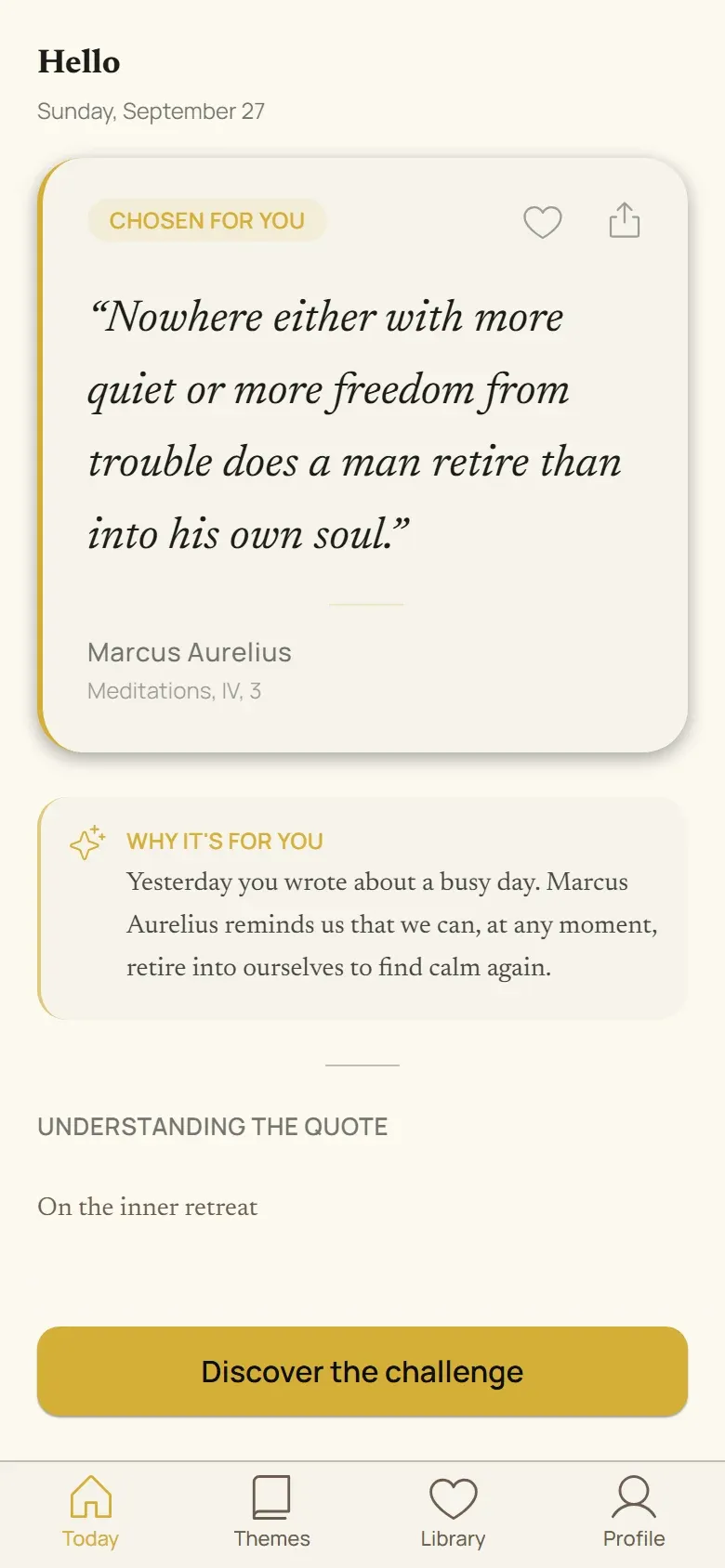
A quote for your day
Chosen every night for what you are going through and your state of mind, rather than picked at random.
Why for you
Every day, a few words that connect the quote to your life, so you understand the choice.
Journeys that reflect you
At the end of each journey, a summary that mirrors your own answers: the way you think, your path, your commitments.
Your reactions
A quote moves you, centres you, gives you hope? Say so in one tap.
Quiet suggestions
If you turn on AI, Adagely notices what you enjoy. No ads, no pressure, and adjustable at any time in Profile.
Journeys at your pace
Multi-step journeys you can spread over days or weeks. Pause and resume whenever you like.
Your questions
Where can I get Adagely?
On Google Play for Android. On iPhone and on a computer, Adagely runs as a web version, in the browser.
How is my daily quote chosen?
If you turn on AI personalization, an AI takes your reactions, moods and activity into account, then explains its choice in the “Why for you” box. Without AI, you still get a quote every day, just less personalized.
Where do the quotes come from?
From great authors, from Antiquity to today. Every quote is sourced and put in context; when an attribution is disputed or apocryphal, the app tells you.
What happens to what I write?
Your journal stays private: it is never published, sold or used for advertising. It only goes to the AI (OpenAI) if you turn on the analysis of your writing: an excerpt of your journal (1,000 characters at most) and your journey answers are then used to choose your quote and write your journey summary. You can change this setting at any time in Profile, and delete your account and your data whenever you like.